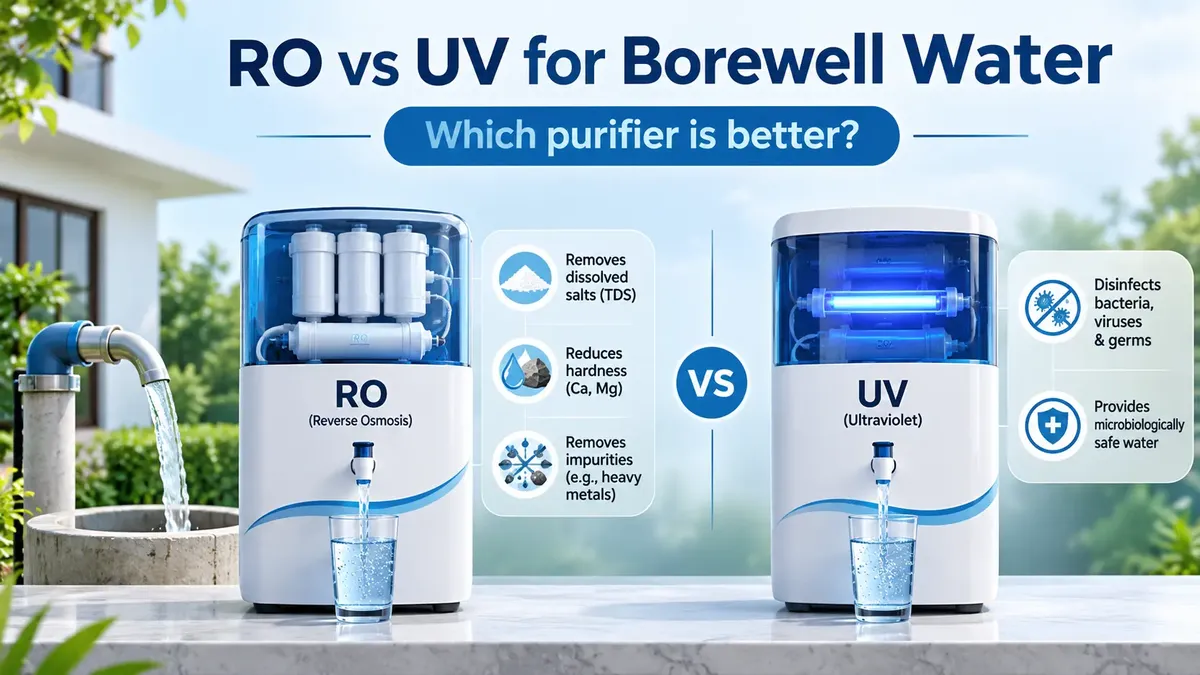
Borewell water often contains dissolved salts, minerals and sometimes harmful contaminants. Choosing between an RO and UV water purifier depends on what is present in your water.
RO reduces dissolved salts and certain chemicals, while UV disinfects water without removing dissolved impurities.
In this guide: - RO vs UV differences - Which technology suits borewell water - Four RO water purifiers to consider
RO vs UV: Quick Comparison
| Feature | RO | UV |
|---|---|---|
| Reduces TDS | Yes | No |
| Reduces hardness | Yes | No |
| Controls germs | Yes, through membrane filtration | Yes, through UV disinfection |
| Reduces dissolved chemicals | Certain contaminants | No |
| Reject water | Yes | No |
| Maintenance | Generally higher | Generally lower |
Quick suggestion: If your borewell water contains excessive dissolved salts or contaminants that RO can reduce, consider RO or RO + UV. For otherwise safe, low-TDS water requiring disinfection, UV may be enough.
Which Is Better for Borewell Water?
RO is generally more useful when borewell water has high dissolved salts, hardness or specific chemical contaminants.
UV is useful for disinfecting clear water, but it cannot reduce TDS or remove dissolved chemicals.
Important: Get your borewell water tested before choosing. A TDS reading alone cannot confirm drinking-water safety.
4 Water Purifiers to Consider for Borewell Water
These four models offer different combinations of filtration, storage and additional features.
Quick Product Comparison
| Model | Storage | Purification | Main Highlight |
|---|---|---|---|
| Aquaguard Delight Aquasaver | Not verified | RO + UV + UF | Water recovery |
| Aqua D Pure 4-in-1 | 12L | RO + UV + UF | Large storage |
| KENT Supreme Plus | 8L | RO + UV + UF | In-tank UV LED |
| Livpure GLO PRO++ | Not verified | RO + UV + UF claimed | Anti-scalant filtration |
1. Aquaguard Delight Aquasaver – For Water Recovery
Aquaguard's Aquasaver range focuses on reducing RO reject water while providing multi-stage filtration.
Key features
- 9-stage RO + UV + UF purification.
- Manufacturer advertises up to 60% higher water recovery compared with conventional RO systems.
- Mega sediment filter helps trap dirt and sand.
- Selected models offer up to two years of filter life, depending on water conditions.
Advantages
- Water-saving technology.
- Multiple filtration stages.
Disadvantages
- Produces some reject water.
- Filter life depends on incoming water quality.
Who should buy it?
Households using borewell water that needs RO treatment and wanting better water recovery should consider this model.
2. Aqua D Pure 4-in-1 Copper + Alkaline – For Large Families
Aqua D Pure combines RO purification with a large storage tank and additional filtration features.
Key features
- 12-litre storage capacity.
- 10-stage purification with RO, UV and UF.
- Copper enrichment and TDS adjustment.
- Automatic operation.
Advantages
- Large tank for households with intermittent water supply.
- Adjustable TDS feature.
Disadvantages
- Copper and alkaline features do not establish additional health benefits.
- Confirm installation and maintenance charges before purchase.
Who should buy it?
Families needing higher storage capacity and RO purification can consider Aqua D Pure.
3. KENT Supreme Plus – For Fast Purification
KENT Supreme Plus combines RO, UV and UF purification with copper and alkaline features.
Key features
- 8-litre storage capacity.
- Purification rate up to 20 litres per hour.
- In-tank UV LED for additional microbial control.
- TDS control technology.
- Wall-mounted black design.
Advantages
- High purification rate.
- Additional UV treatment inside the storage tank.
Disadvantages
- Smaller tank than Aqua D Pure.
- Regular filter maintenance is necessary.
Who should buy it?
Households looking for relatively fast purification, an 8L tank and in-tank UV treatment can consider KENT Supreme Plus.
4. Livpure GLO PRO++ – For Hard-Water Areas
Livpure GLO PRO++ is listed with RO, UV and UF filtration and an anti-scalant cartridge. Exact-model specifications need confirmation.
Key features
- Claimed 7-stage purification.
- Anti-scalant cartridge designed to reduce membrane scaling.
- Silver-impregnated post-carbon filtration.
- Wall-mounted design with LED indicators.
Advantages
- Anti-scalant feature may help with hard-water-related scaling.
- Multi-stage filtration.
Disadvantages
- Exact storage capacity needs confirmation.
- Applicable inlet TDS limit needs confirmation.
Who should buy it?
Households with hard borewell water may consider this model after confirming its anti-scalant specification and supported water-quality limits.
Things to Check Before Buying
- Water quality: Test TDS, hardness, bacteria and relevant chemical contaminants.
- Purification technology: Choose filtration that addresses your actual water-quality problems.
- Storage: Consider your family's daily water requirements.
- Maintenance: Check filter replacement costs and local service availability.
Frequently Asked Questions
Is RO better than UV for borewell water?
RO is generally preferable when dissolved salts or other RO-removable contaminants exceed safe limits. UV alone cannot remove these impurities.
Can UV remove TDS?
No. UV disinfects water but does not reduce dissolved salts or hardness.
Is RO necessary for every borewell?
No. The need for RO depends on laboratory water-test results, not simply whether the source is a borewell.
Final Verdict
- Aquaguard Delight Aquasaver: Consider for better water recovery.
- Aqua D Pure 4-in-1: Consider for larger storage capacity.
- KENT Supreme Plus: Consider for faster purification and in-tank UV.
- Livpure GLO PRO++: Consider for its claimed anti-scalant feature, subject to specification verification.
For borewell water, choosing the correct filtration technology matters more than the number of purification stages. Test your water first and select a purifier that addresses the contaminants found.